

Navigating Louisiana Workers’ Compensation: Your Practical 2026 Guide
Experiencing a workplace injury is overwhelming. While you are trying to heal, navigating insurance claims adds an extra layer of stress. At Montiel Hodge, we believe you shouldn't have to fight the system alone to get the benefits you are legally owed.
Here is what you need to know to protect your claim and your financial future.
The 30-Day Golden Rule: Report Your Injury Immediately
The single biggest mistake injured workers make is waiting to report an injury to see if the pain goes away. Under state law, failing to officially report your injury can completely derail your claim.
The Deadline: You must notify your employer in writing within 30 days of the accident (La. R.S. 23:1301).
The Format: Do not rely on a conversation. Send an email, text, or formal letter detailing the date, time, location, and exact circumstances of the injury, and keep a copy for your records.
Who is Covered Under Louisiana Law?
Louisiana has a remarkably low coverage threshold. Under La. R.S. 23:1168, virtually any business with one or more employees must carry workers’ compensation insurance. This protection starts on your first day and applies to full-time, part-time, temporary, and seasonal workers.
Beware the "Independent Contractor" Label
Employers often try to avoid paying benefits by labeling workers as independent contractors. However, under state law (La. R.S. 23:1021(7)), if you spend a substantial amount of your time performing manual labor for a business, you are legally considered an employee entitled to coverage.
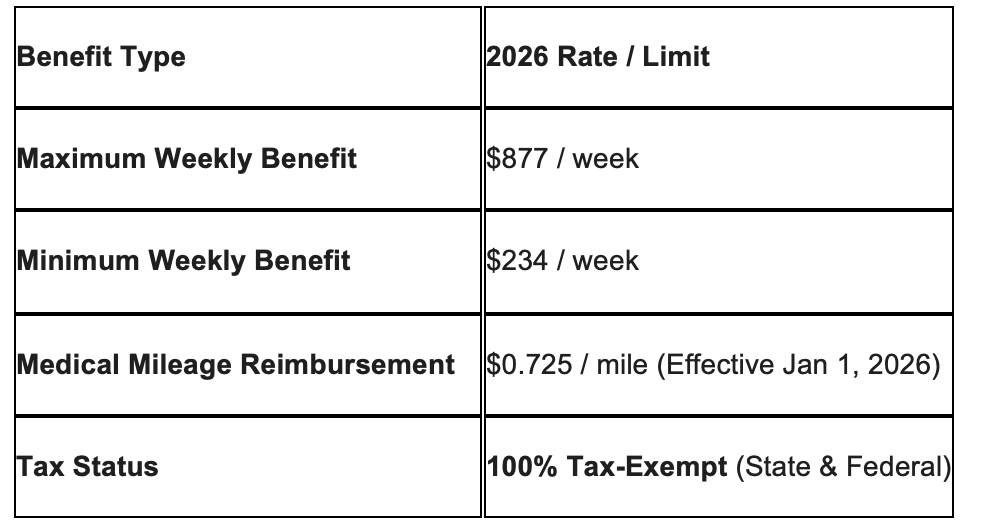
2026 Louisiana Workers' Comp Benefit Rates
The Louisiana Workforce Commission sets benefit limits annually. Through August 31, 2026, wage replacement benefits are calculated at 66.6% (or 2/3) of your average weekly wage, subject to these state caps:
Types of Disability Benefits Available
Depending on how your injury impacts your employment, you will fall into one of four benefit categories (La. R.S. 23:1221):
Temporary Total Disability (TTD): Paid if you cannot work at all while recovering. There is a 7-day waiting period, but if your injury keeps you out for more than 14 days, you are retroactively paid for that first week.
Supplemental Earnings Benefits (SEB): Paid for up to 520 weeks if you return to a "light-duty" or lower-paying role that pays less than 90% of your pre-injury wages. It covers 66.6% of the wage gap.
Permanent Partial Disability (PPD): Provides a set number of weeks of compensation if you suffer a permanent anatomical loss (like the loss of a hand or foot).
Permanent Total Disability (PTD): Provides weekly wage benefits for life if you are permanently and completely unable to engage in any gainful employment.
Your Medical Rights: Unlimited Care & Choice of Doctor
Under La. R.S. 23:1203, medical benefits for a workplace injury are unlimited and carry lifetime coverage. You pay $0 out of pocket—no deductibles and no copays for approved treatment.
You Choose Your Doctor
Under La. R.S. 23:1121, you have the right to select your own treating physician within any medical specialty. Your employer or their insurance company cannot force you to use a company doctor for your ongoing care. Choose carefully, as switching doctors within the same specialty later requires insurance approval.
What to Do If Your Claim Is Denied
Insurance companies frequently deny legitimate claims by citing "pre-existing conditions" or arguing the injury wasn't work-related. If your claim is disputed or cut off, the legal dispute process involves:
Filing Form WC-1008: Initiates a formal Disputed Claim for Compensation with the Office of Workers’ Compensation Administration (OWCA).
Mediation: A mandatory, confidential meeting where both sides try to resolve the dispute without a trial.
Administrative Hearing: If mediation fails, your case goes before a Workers’ Compensation Judge, which functions like a trial with medical evidence and witness testimony.
When to Call Montiel Hodge
If your injury is minor, your employer is cooperative, and your checks and medical bills are paid on time, you may not need an attorney.
However, you should seek experienced legal representation immediately if:
Your claim is denied or your weekly checks suddenly stop.
The insurer refuses to authorize necessary medical treatments or surgeries.
Your employer pressures you not to file a claim or threatens retaliation.
Your injury is permanent and will impact your long-term ability to earn a living.
If you have questions about a workplace injury, reach out to Montiel Hodge today for a straightforward, honest evaluation of your case.